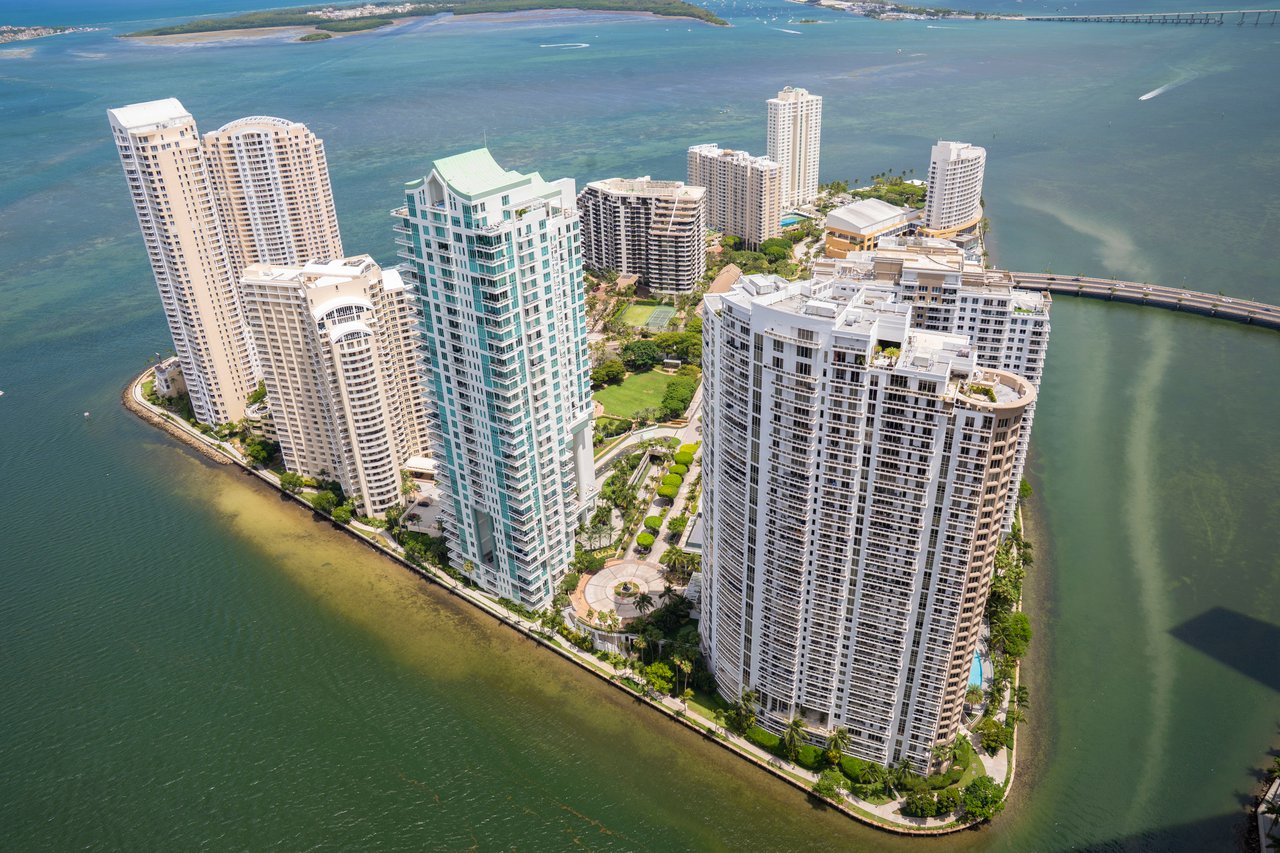
At 8:30 a.m. on Sunday, April 12, a twenty-three-story building disappeared in twenty seconds. Residents who had not left the island by 7 a.m. sheltered in place, felt the tremor through the walls, and watched a dust cloud sweep inland and dissipate before the coffee cooled. The Brickell Key Bridge stayed closed until 1:30 p.m. By afternoon, the southern tip of the island was a debris field, and the view from every north-facing balcony on Claughton Island had permanently changed.
That is the correct starting point for any honest summer briefing on Brickell Key. Not restaurant listicles, not pool-day roundups. The physical shape of the island shifted, and the summer that followed is the first one being lived inside that new shape. If you live here, you already feel it in small ways: the walking loop, the sight lines, the dinner options, the traffic pattern on Brickell Key Drive. Here is what those small ways add up to.
Twenty Seconds Removed a Lot More Than a Hotel
The old Mandarin Oriental Miami had anchored the southern tip of Brickell Key for more than 25 years, and its 23-story tower and adjacent parking structure came down in a controlled demolition that was the largest Miami implosion in over a decade. The hotel had already opened in 2000 and closed permanently on May 31, 2025, so the room service and lobby traffic had been gone for almost a year. What went with the building on April 12 was the rest of the ecosystem attached to it: MO Bar, the ballrooms, the meeting rooms, the porte-cochere queue of black cars that used to spill onto Brickell Key Drive on Friday nights.
For a resident, the practical read is this. The southern quarter of the island is now a construction staging area, and it will stay that way for a while. Debris removal is expected to take up to six months before preparations for groundbreaking advance, and groundbreaking on the replacement project is anticipated in late 2026, with construction completion targeted for 2030. Summer 2026 is the quiet interval between the loudest twenty seconds in island history and the first pile driver.
The Dining Vacuum, and Who Just Filled It
The Mandarin's slow fade had a second-order effect that residents felt earlier than the implosion. When the hotel closed for demolition planning, La Mar left the island after the Mandarin Oriental Miami began its big renovation in May of 2025, and the neighborhood has been living without an obvious answer to the question of where to go for dinner without crossing the bridge to Brickell. For most of the last twelve months, a Brickell Key resident who wanted a proper dinner was either walking across the bridge or ordering in.
That changed on April 9, three days before the implosion. The Mexican, a contemporary Mexican restaurant, officially opened its doors to the public on April 9 in Brickell Key, at 601 Brickell Key Drive. The room is not small. The Mexican Miami spans more than 10,000 square feet and accommodates over 330 guests across expansive indoor and outdoor spaces, and its Dallas predecessor was named one of the "World's Most Beautiful Restaurants" by Prix Versailles in 2023.
The interior, by Monterrey-based Paulina Morán, leans on floor-to-ceiling golden double doors that open into a tequila gallery lined with hundreds of bottles, followed by a central bar and dining room framed by limestone archways, geometric tile flooring, and floor-to-ceiling windows looking out at Biscayne Bay and the Brickell skyline. The bar opens at 4 p.m. daily. If you are a resident who used to end the workday at MO Bar with the bay to your right, the closest architectural substitute now sits two blocks north, on the other side of the island, with the skyline to the west instead of the water to the east.
Whether that trade lands depends on the person. What is not debatable is the practical arithmetic: the island went from zero major restaurants to one in a single week, and that one is designed to seat roughly a full commercial airliner's worth of guests every night.
The Loop Is About to Get Interesting
The other summer variable most residents interact with daily is the baywalk. Runners, dog walkers, stroller pushers, everyone. The loop is roughly 1.25 miles and it has been the island's shared living room for two decades.
That living room is scheduled for renovation. The Swire-controlled master association on Brickell Key is planning a $42 million seawall replacement and baywalk improvement project on the island. That is a serious number for what is technically a private island association budget, and it signals that the seawall work is not cosmetic. Residents who have watched king tides push water over the eastern edge in September already understand why.
The reality of a $42M perimeter project on a 44-acre island is that you will not walk the full loop uninterrupted for the duration. Expect phased closures, temporary rerouting around the southern demolition footprint, and construction fencing that moves counterclockwise as work progresses. If your summer routine is a sunrise loop, factor in that the western baywalk may become the primary uninterrupted stretch while the eastern and southern sides cycle through work zones.
The Next Domino Is Already Being Set Up
For anyone reading the island as a market rather than a home, the more interesting news broke two weeks after the implosion. The Pérez family's Related Group and David Martin's Terra are negotiating a condo buyout with owners at a waterfront building on Miami's Brickell Key, and a buyout of the 134-unit building at 800 Claughton Island Drive would likely exceed $1 million per unit, with one source pegging the price closer to $1.5 million per unit, or roughly $200 million for the entire building. The building in question is the St. Louis, and it sits directly next to the Swire demolition site.
The significance is not the dollar figure. It is the precedent. If the buyout moves forward, it would mark the first redevelopment of an existing condo building on Brickell Key since the island was developed decades ago. Every other tower on the island has held its original ownership structure since delivery. If Related and Terra clear the St. Louis, the ceiling on what any Brickell Key building is worth stops being a comparable resale and starts being a developer's land value.
"It's really hard, especially domestically, to get a luxury deal to pencil without at least some small residential component."
Marriott CEO Anthony Capuano's line, delivered to Hospitality Investor, is the industry framing behind everything happening on the southern half of the island. The Swire replacement project is a two-tower ultra-luxury residential and hospitality development with a 34-story North Tower that will include 70 private residences, 28 Hotel Collection residences, and a new 121-key Mandarin Oriental hotel, positioned as the brand's future North American flagship, with a 66-story South Tower containing 228 private residences. The residential half of the math is doing the heavy lifting. Two penthouse transactions at $49.9 million each atop the South Tower closed in March, setting a record for the highest-priced condominium sales on mainland Miami at approximately $6,300 per square foot.
For a current resident, that record is a signal about what the neighbor will look like when the fencing comes down in 2030. For a current owner, it is a data point that repositions the entire island's price ceiling.
What Summer Actually Looks Like, From Here
Put it together and the shape of the season is unusual. The island is quieter than it has been in twenty-five years because the hotel population is simply gone. The construction is loud in bursts but not continuous, since the site is in debris-removal mode rather than vertical work. The dining count went from zero anchors to one significant one. The baywalk is intact for now but on borrowed time. And the next redevelopment story is already being negotiated one lot north.
If your summer plan involves crossing the bridge, the mainland complements are worth noting. Seia, the contemporary Italian restaurant and private members' club opening atop 830 Brickell in March 2026, added a serious skyline option in Brickell proper, curated by the Bastion Collection, the international restaurant group behind ten Michelin stars since 2019, in collaboration with Oko Group. Rosa Sky and Sugar at EAST remain the higher-elevation options for anyone who used to book MO Bar for a slower drink.
None of this reads as bad news for someone who chose Brickell Key for the reasons Brickell Key was originally designed to deliver: a private-feeling residential island with a bay walk, a bridge, and a controlled entry point. What has changed is the mix. The hotel era is over. The branded-residence era is being poured, literally, into the same footprint. Summer 2026 is the pause between the two, and it is the last summer the island will look like this.
If you own on the island and want a considered read on what these shifts mean for your specific building, floor, or exposure, The Paulie Group is available for a private conversation.