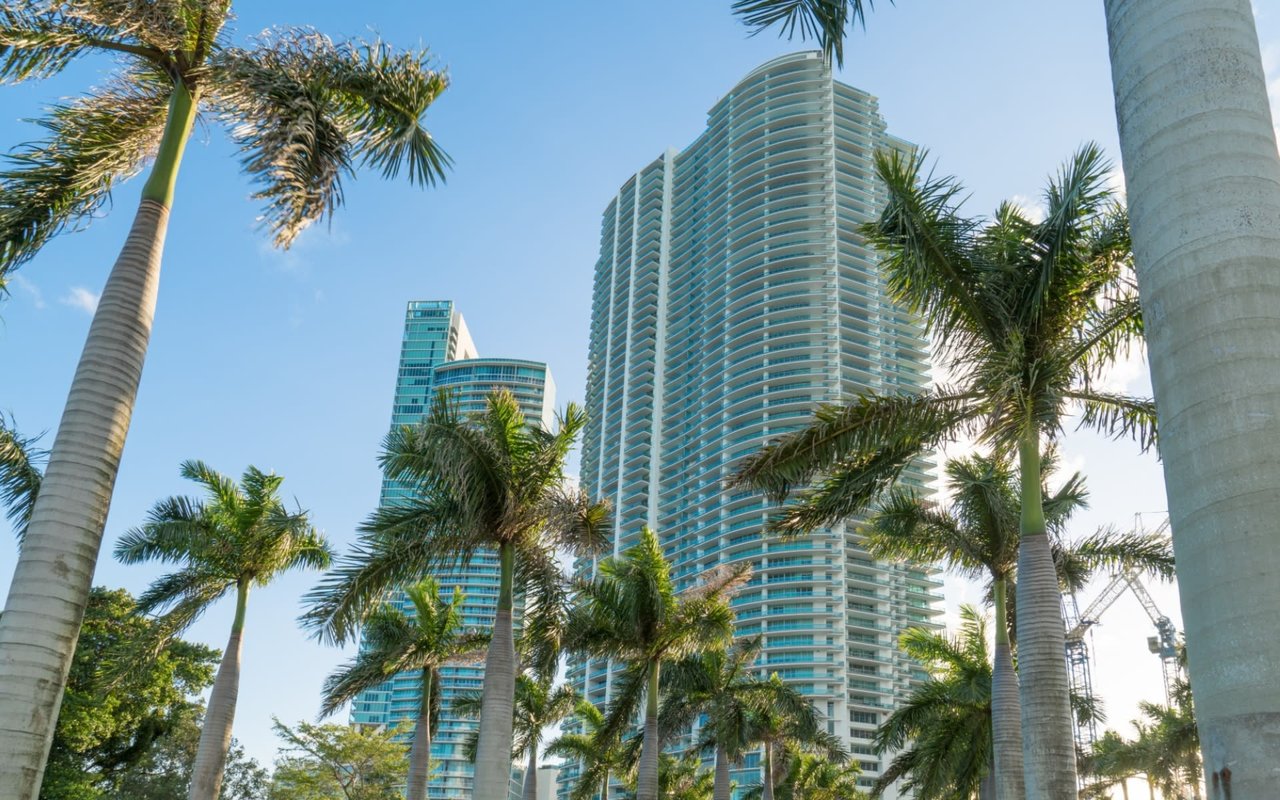
Walk into any Brickell tower today and two elevators can carry buyers to two entirely different economies. One arrives at a resale one-bedroom priced near the neighborhood median, sitting on the market for months. The other opens onto a branded residence trading at nearly three times the per-foot number, sold before the crown was ever craned into place.
The portals report a single median. Buyers comparing Brickell to Coral Gables, Coconut Grove, or a second home in Miami Beach see that number and think they understand the trade. They don't. The median is a composite of two markets that behave nothing alike, and the friction that decides whether either purchase pencils out has almost nothing to do with the list price.
The Median Is a Composite, Not a Market
Sources tracking Q1 2026 closings put the general Brickell condo median somewhere between $620,000 and $790,000, depending on whether the sample leans toward the older resale stock along Brickell Avenue or the newer inventory west of the FEC tracks. The general-market per-foot number sits near $657 to $695. Move up one tier into the luxury segment and Q1 2025 data put the median sale at $1.47 million, roughly $937 per square foot. Push into branded pre-construction and the pricing sheet changes vocabulary entirely: Baccarat Residences and Mandarin Oriental Brickell are trading in the $2,000 to $2,600 per foot range, with the average across all Brickell pre-construction landing near $1,650.
Those tiers do not compete with each other. They barely correlate.
Segment | Q1 2026 pricing | Supply signal | Buyer leverage |
|---|---|---|---|
General resale | ~$657 to $695/sqft, median near $660K | ~17 months of supply, ~113 days on market | Meaningful |
Luxury resale (Q1 2025 comp) | ~$937/sqft, median ~$1.47M | Segmented by view and building | Selective |
Branded pre-construction | ~$1,650/sqft average, $2,000 to $2,600 at the top | Sold off developer schedule | Minimal on price, real on terms |
The resale slowdown is genuine. Seventeen months of standing inventory and mortgage rates easing toward 6.3% mean a disciplined buyer working the resale market has room to push on price, inspection period, and closing costs. That leverage evaporates the moment the same buyer walks into a Cipriani or St. Regis sales gallery, where the developer sets the schedule and the reservation queue enforces it.
Where the Real Friction Lives
If a buyer only remembers one thing from this post, it should be this: in the Brickell resale market of 2026, the reserve study matters more than the list price.
Florida's post-Surfside legislation now requires milestone structural inspections for condo buildings three stories or taller once they reach 25 to 30 years of age, and mandates fully funded reserve accounts. Brickell's older stock, including several trophy addresses along Brickell Avenue, is squarely inside that window. HOA fees already run between roughly $0.80 and $2.50 per square foot per month, which on a 2,000-square-foot unit can clear $5,000 monthly before a mortgage payment. A single underfunded reserve turns that carrying cost into something worse: a special assessment landing without warning.
The 2026 assessment calendar circulating among Brickell buyers is instructive. Plaza on Brickell has flagged roughly $8,500 per unit for elevator modernization. Santa Maria is running about $12,000 per unit over two years for roof work. Brickell on the River has a parking resurfacing assessment near $5,400. These are the assessments already announced. The ones that damage a purchase are the ones the seller learns about a week after closing.
A buyer negotiating a resale unit should demand written answers to five questions before waiving inspection:
- What is the current reserve balance, and against which components?
- Has the building completed its milestone structural inspection, and are the findings closed out?
- Are there special assessments pending, planned, or under board discussion for the next 24 months?
- What is the assessment history over the past five years?
- What is the current delinquency rate on monthly dues?
None of those answers are available on a listing portal. All of them are available if the buyer's representative knows which board member to call.
What a Special Assessment Actually Costs
On a $600,000 general-market unit, closing costs already run $12,000 to $18,000, taxes near $10,800 annually, insurance including windstorm and flood between $3,000 and $3,500. Layer a single $15,000 special assessment on top and the effective first-year cost of ownership shifts more than any price reduction a buyer is likely to negotiate. The reserve conversation is not a formality. It is the trade.
The Pre-Construction Tier Is Running on a Separate Clock
While resale sellers are cutting price and extending inspection periods, the branded pipeline is topping off on schedule. On June 23, 2026, the two residential towers at One Brickell Riverfront installed architectural crowns atop both LOFTY Brickell and The Standard Residences, bringing both towers to their full architectural heights. Delivery is targeted for August 2027.
Meanwhile, Viceroy Brickell has already crossed the finish line. The world's first fully residential Viceroy-branded building completed construction, received its Temporary Certificate of Occupancy in May, and is now welcoming its first owners. Designed by Arquitectonica, the 45-story tower comprises 420 residences with interiors by Meyer Davis Studio. Owners may rent their residences up to 12 times per year with a minimum stay of 30 days.
The rest of the branded field is filling in around them. Baccarat Residences at 444 Brickell continues Related Group's riverfront corridor next door to Viceroy. Cipriani Residences is rising 80 stories in South Brickell with pricing from $1.7 million. St. Regis Residences at 1809 Brickell, a Related and Integra collaboration, opens at $4 million with floor plates from 2,100 to 7,000 square feet. Mandarin Oriental Brickell extends the brand's Miami footprint beyond its Brickell Key hotel. Mercedes-Benz Places, ORA by Casa Tua, 888 Brickell with Dolce & Gabbana, and The Residences at 1428 Brickell round out the pipeline. Melia Miami Brickell topped off in May and is on track for 2027 delivery, marking the Spanish hotel chain's U.S. debut with 111 condo-hotel residences designed by DTI Architects.
Buyers in this tier are not negotiating on price. They are negotiating on line selection, floor placement, deposit schedule, and rental rights.
The resale market rewards patience and diligence. The pre-construction market rewards position in the reservation queue. Confusing which set of rules applies to which trade is the most expensive mistake a buyer can make in Brickell right now.
FIFA, Rentals, and the Building-by-Building Rulebook
Miami's role as a FIFA World Cup 2026 host city has already changed the rental math on buildings that permit shorter stays. Icon Brickell Tower 3, operating as W Miami, remains the flagship for genuinely flexible short-term rentals. Viceroy Brickell allows 12 rental periods per year at a 30-day minimum, which fits corporate and executive demand rather than tournament weekends. Cipriani and St. Regis are structured around annual leases and wealth preservation. The Standard Residences and ORA by Casa Tua sit at the more flexible end of the spectrum by design.
A buyer underwriting rental income cannot rely on the neighborhood as a category. The rental rulebook is written building by building, and the difference between a 30-day minimum and daily flexibility often decides whether a unit clears its carrying costs.
FAQ
Why is Brickell resale sitting on 17 months of supply if the branded towers are selling out? The two segments draw different buyers. Resale demand is rate-sensitive and dominated by end users and yield-focused investors comparing per-foot numbers across Miami neighborhoods. Branded demand is dominated by international buyers treating dollar-denominated Miami real estate as a wealth-preservation instrument, largely indifferent to weekly rate movement. A slowdown in one does not signal a slowdown in the other.
Does the milestone inspection law apply to newer Brickell towers? The 25 to 30 year threshold means most towers delivered after 2000 are not yet in the inspection window, but reserve funding rules apply broadly. A five-year-old building can still be underfunded on reserves. The building age is a shortcut, not an exemption.
Is the buyer leverage in resale likely to hold through the rest of 2026? Inventory has widened enough that headline leverage is real, though it is concentrated in older buildings and units with clear defects such as unresolved reserve questions or dated finishes. Move-in-ready inventory in the strongest buildings is still absorbing at close to ask. The leverage window is a segment story, not a market story.
Brickell is not a market where a single median tells a buyer what they are actually buying. It is a stacked market with two clocks, two rulebooks, and one very consequential set of questions to ask before signing anything. If you are weighing a Brickell purchase against another Miami enclave, or comparing branded pre-construction against resale within the same block, The Paulie Group offers the private, informed guidance this market rewards. Contact us to begin the conversation.